Making sense of the economy (early 2026 edition) - Geoeconomics, China and Technofeudalism
"Current economic policy demonstrates that the primacy of growth has already been replaced with other measures such as national resilience. In a certain sense, under the new geoeconomic paradigm, the economy has become more of a means than an end."
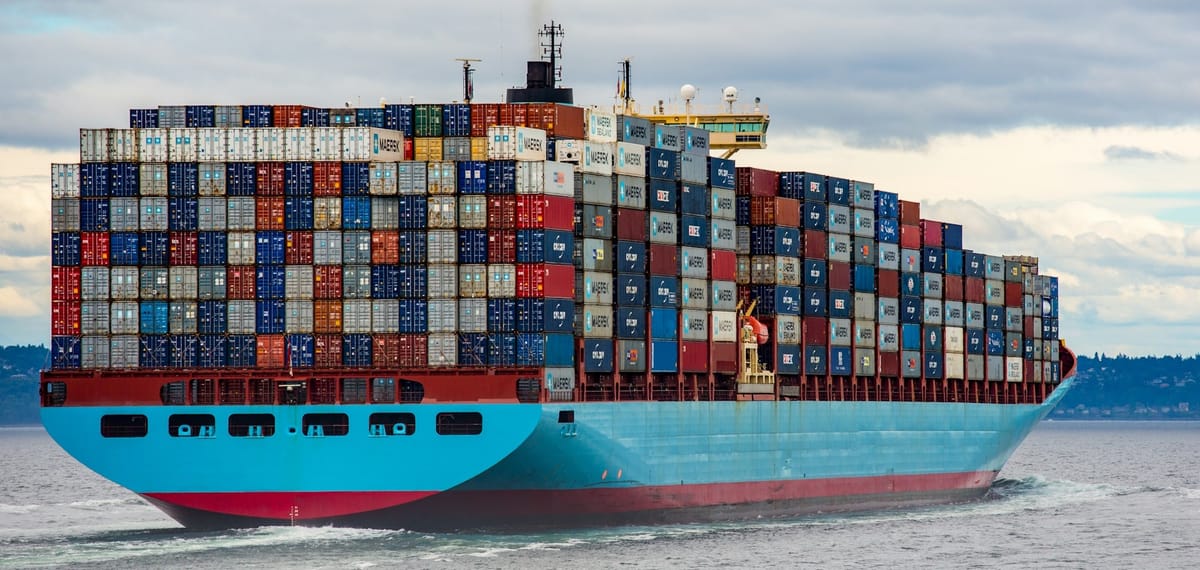
Why your mental model of the world economy is probably outdated
Growth keeps disappointing. Political camps talk past each other with growing volume and shrinking coherence. Supply chains that were supposed to create abundance are now axes of conflict. And AI, despite the noise, can't account for any of it: the disruption started earlier and runs deeper. Most business strategy advice you'll encounter is still built on an economic worldview that stopped being accurate roughly a decade ago. The new frameworks haven't made it into the mainstream yet. This post is an attempt to accelerate that.
The strategies that have started to break down
A lot of leaders - executives, investors, politicians - are mentally still on the unbounded growth train, expecting an increase in output of both the global and national economies as well as their businesses, to benefit from surplus as they've been used to since somewhere around the 1980s. But for a lot of economies and enterprises out there, it's not really happening. Something is stuck. Yes, concern is echoing through boardrooms and corporate coffee kitchens alike about the potential effect of AI on the job market; but given the slow adoption and still questionable utility of AI to actual economic output, this can't be the explanation.
Our attention, meanwhile, is torn between different narratives. Camp retro-neolib, still a big favorite with business leadership, continues its spin on 1990s neoliberal globalization, calling for further deregulation, little to no involvement of the state, and free-moving capital; blaming taxes and red tape on stagnation. Often, this is combined with a strong techno-optimism, the belief that progress of technology must be pursued at all cost (as it is inevitable) and will certainly lead to a better world - a view that, if you do any study of history, may not be backed up by so much data.
Camp right-wing populist preaches that each country must take care of themselves, guard its own economy and resources, re-industrialize and extend its own military and economic power across others to persist (mostly while doing the opposite and getting rich off of it).
Camp de-growth is convinced that the only way out of the ecological and economic poly-crisis is to leave behind GDP growth and move towards a reduction of production and consumption. They are countered by the positivist camp (think "Factfulness" or "It's not the end of the world" by Hans Rosling or Hannah Ritchie, respectively) which points out just how much GDP growth is required to lift a country out of poverty and how much we have left to go globally, and also demonstrates that growth in some industries has already successfully de-coupled from resource consumption, falsifying the idea that growth always comes at cost to the planet.
At the same time, watching the news, we read about Chinese dominance in markets that have traditionally been European or American staples (most evident exhibit: automotive). We witnessed how German renewable tech, once a world leader in things like wind turbines and solar, got killed off a few years ago by structural government decisions and is now obsolete, having been overtaken by Asian companies, backed by countries like China who installed more renewables in '24 and '25 than the rest of the world combined, all without having any notable Green Party that I am aware of.
While I am writing this post in April 2026, a new war in Iran - started by the USA with unclear goals - is escalating conflicting world views and causing a major crisis in oil and gas availability, seeing politicians that just recently worked hard to push back on renewables struggling to find their narrative on rising gas and oil prices, tiptoeing around interventionism.
We can't just ignore these conflicting views and data points. In our lives, both business and private, our decisions - and their short and long term outcome - are influenced by and dependent on what's happening around us. In order to know whether we commit to an ambitious growth plan or need to pivot our business model, outsource or insource, onshore or offshore, buy hardware or trust the cloud, rebalance our ETFs, borrow money or save money, we need a solid big picture view of what's going on.
Finding a new perspective on our reality
In this attempt to re-calibrate my world view at the beginning of the year, I read a few books I think are worth sharing because they help get a better picture of what's going on. I'll build them into a narrative below.
First, unless you're in the privileged position to run one, it's crucial to understand how a truly globalized organization currently works. What part of their organization is it that became global, and how do they protect their IP? How did they transform their supply chains and their manufacturing, and why? How does this make them more resilient, or more vulnerable? And is the promise of globalized supply chains - more choice, lower cost, lower dependence, etc. - true, or is it the opposite; with what we perceived as free market globalization just a long, long play to exercise nation state power and acquire truly world-leading know-how that locks companies into a concentrated network of suppliers, with no way out because the required knowledge simply isn't in-house any more?
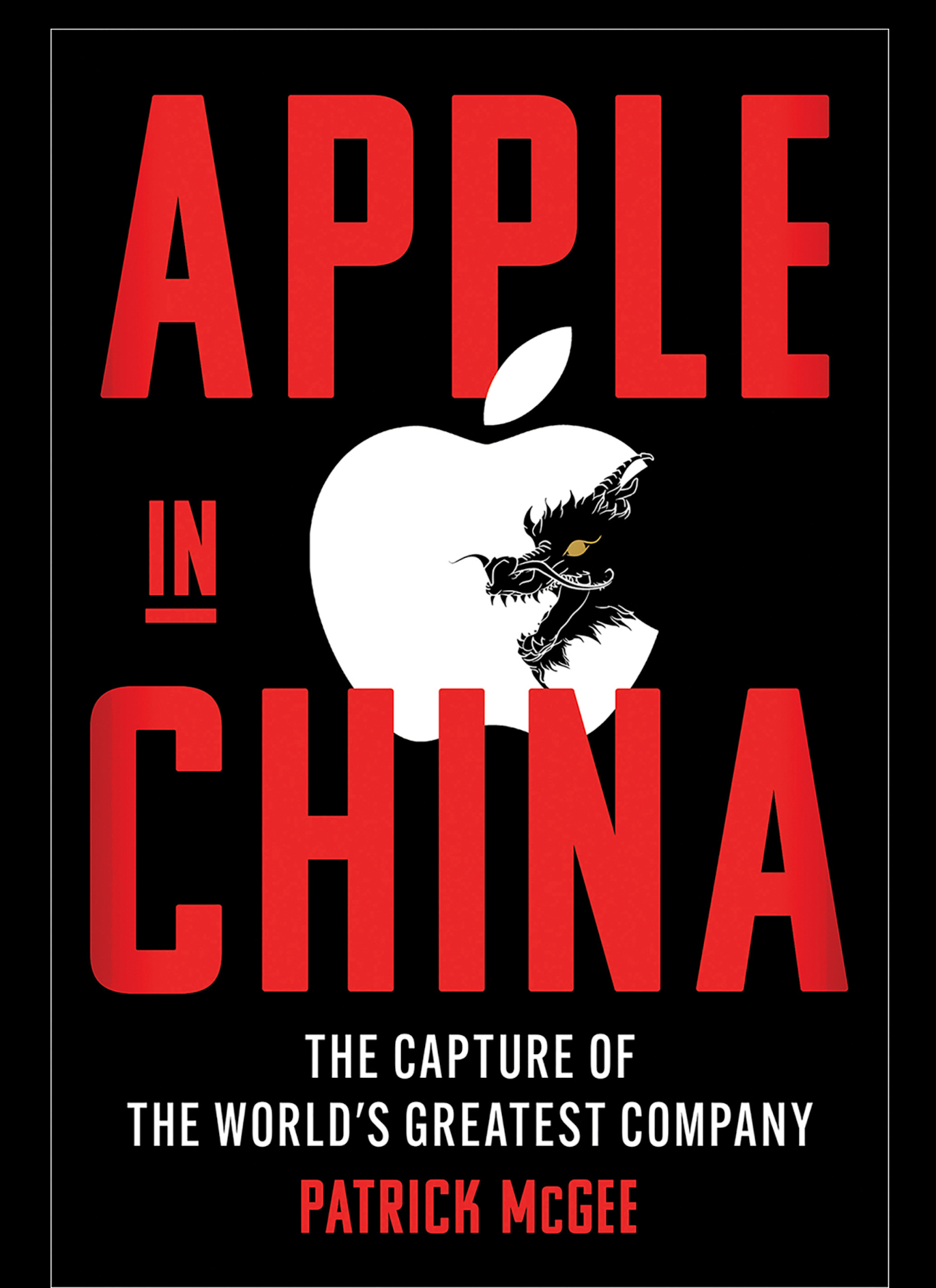
"Apple in China" by Patrick McGee provides insights of how Apple, a world leading company, got itself more and more entangled into a dependence on not just external manufacturing, but also political goodwill, as the price for attaining the market position and valuation they have.
It gives you a better understanding of how the Tim Cooks of this world happily allowed the concentration of crucial engineering know how in China to boost their short term competitiveness - trading it in for the strong competition that followed once local companies picked up the that know how, all the while making themselves susceptible to Chinese state influence. It's worthwhile reading until the end to fully understand how Apple and its Chinese suppliers - and competitors - evolved and transformed, and how this directly works into US geopolitics. By following this narrative, I learned that by Chinese economic policy, regional governments can provide land for factories for free and support in acquiring workers, often from faraway regions, to staff the factories. At the same time, they typically push for the establishment of joint ventures with Chinese companies. What you can also learn is that it's hardly possible to lock your knowledge into a supplier. Talent is bought off at high prices and suppliers usually try to reduce their dependence on a single customer, even if it is a large one like Apple. What was especially interesting to me was the detailed account of the decline in engineering and manufacturing know how in the US, which at this point seems to be almost beyond a point a point of no return; and its rise in China, which has quickly moved beyond copying into a world market leading position. Huawei and Xiaomi are now rivaling Apple and Google in R&D spend and have entered the top 5 in US patent applications. But in contrast to Google and Apple, they are located in the (more or less only significant) country in the world that can actually manufacture the things they research, at scale and cost.
With this case study in mind, consider the increasing popularity of tariffs in the US/China trade war. Consider the discussions around export restrictions on semiconductors and AI chips as well as AI tools, all happening while new free trading agreements continue to be negotiated as economies scramble to secure their own supply chains from food to rare earths by controlling foreign investment, or extending their power through such investment (like China's Belt and Road initiative). How does this still connect with globalization, and the ideas of neoliberalism?
The book that helped me find better concepts for what's happening to the world order as we knew it is "Geoökonomie" (translatable to "Geoeconomics" or Geoeconomy" - currently only available in German to my knowledge) by Milan Babic. With clear language, the author starts by explaining how neoliberal globalization came about after the end of Bretton Woods, and what effect it had on the world order: Global bilateral trade between nationally defined economies was replaced by complex transnational economic dependencies that go much deeper than trade, especially with the much expanded possibility of direct investments of foreign companies across economies. At the same time, globalized and deregulated financial markets allowed for the creation of novel financial instruments and for finance to rise to global power, and create a new caste of global lawyers, bankers, and advisors which enabled an explosion of global mergers and acquisitions and the rise of the Big 4 consultancies to global relevance.
What was important for me to recap was that it wasn't about global trade; it was about global economic entanglement, in the form of direct investments, complex global supply chains, and the creation of global markets. The role of nation states during this period was thus, Babic writes, mainly to adapt and implement internally their institutions and socioeconomic relationships to the requirements of global capital movement.
With what marks the end of neoliberal globalization as a movement, nation states have started to rediscover their external influence, and implement measures and instruments that aim to make global trade available for political and economic benefit, allowing for relative gains and limiting the threat of losses to a nation's welfare. Instruments and tools that have previously been equally accessible, such as global finance networks, are now increasingly subjected to a hierarchy with the aim to realize national interests. In such a world, passive neoliberal states are at loss and need to adapt. Supply chains are becoming the axis of new conflicts.
At the same time, global capitalism is suffering from a structural problem. Babic suggests that the decline in growth in the last decade - after 40 years of positive growth - causes a legitimacy problem for a growth-oriented global order, thus opening the door for populism and reactionary forces. At the same time, for selected parts of the economy, current economic policy demonstrates that the primacy of growth has already been replaced with other measures such as national resilience. In a certain sense, under the new geoeconomic paradigm, the economy has become more of a means than an end. This, however requires a re-orientation of the purpose of politics and the definition of what makes politics functional. The problem we are now facing by this functional crisis of politics is that the medium to long term transformation projects that we would desperately need - be it the construction of resilient local supply chains or effective measures to decarbonize - are increasingly hard, if not impossible, to facilitate.
One thing I really liked in Babic' work is his point that the concept of "The End of History" as coined by Francis Fukuyama in his 1992 book - i.e. the idea that liberal democracy is the final ideological evolution of mankind and that neoliberal globalisation will, for lack of credible systemic alternatives, slowly prevail to be the global order of things - has started to erode, and we are in the midst of a re-opening of political discourse. After decades of politics building on this principle (example: Germany being friends with Putin in the belief that this will change Russia) I sincerely hope European politicians will come to understand this shift and react to it as well. Connecting back to Apple in China, Babic provides a fitting framework to understand how the new geoeconomics nations work to make the global economy available for their own national purposes, as opposed to facilitating its free flow.
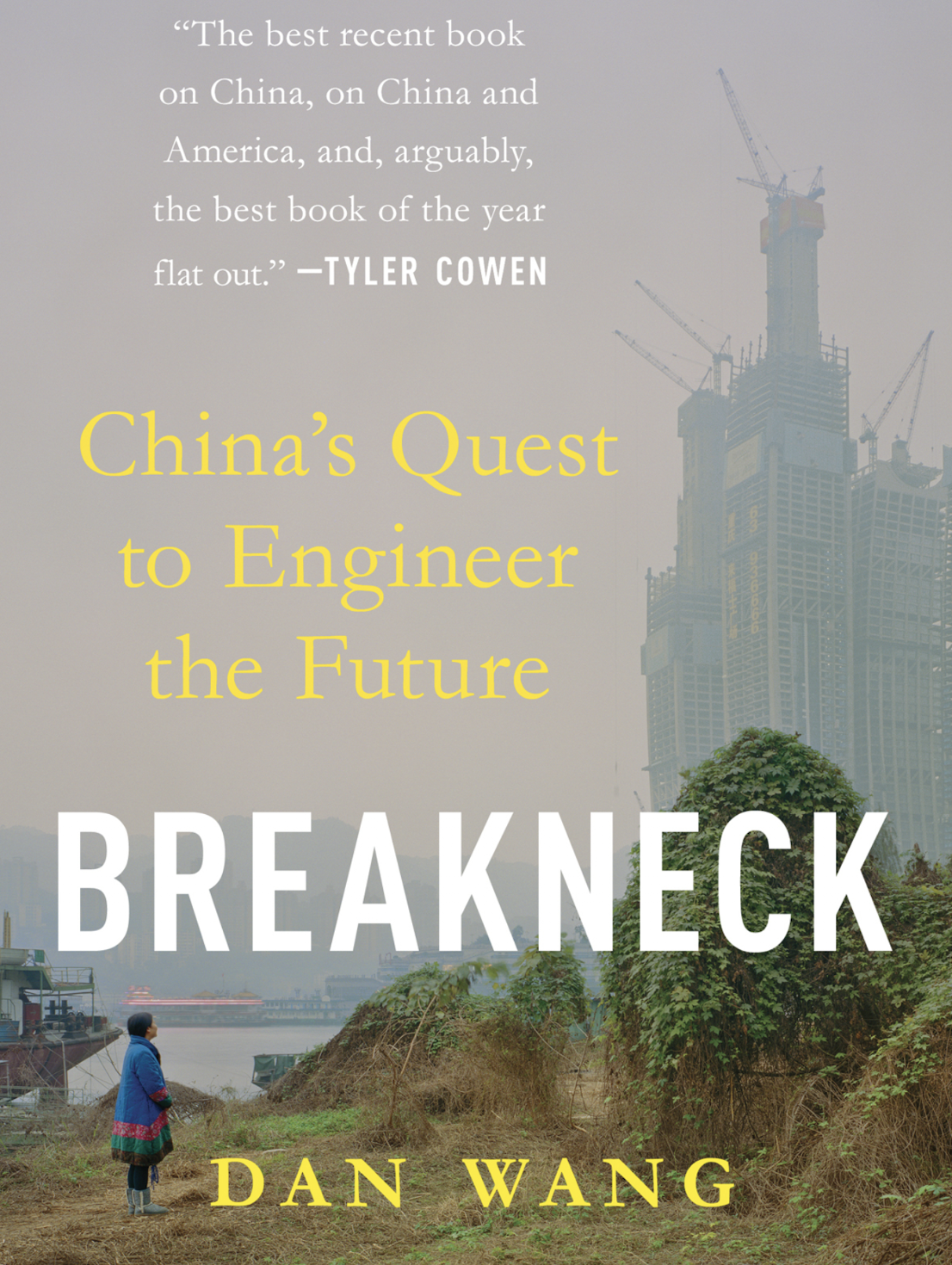
With the mental framework of Geoeconomics, it was interesting to read Breakneck by Dan Wang. In similar vein, he states that he finds "20th century labels like capitalist, socialist, or, worst of all, neoliberal" inadequate to describe what's going on. What Wang sketches out in his book, which compares progress in China with that in the US, is the difference between two completely different mindsets, which he calls the engineering state (China) and the lawyerly society (USA). The answer of the engineering state - a state run by engineers, answering only to science and to the political goals set out by their leader - to problems is mainly: to build. Whether it's physical infrastructure, such as housing, transportation, or means of production; or control infrastructure, like those created to enforce the one child policy or the covid lockdowns. How much are they spending? Figures from a few years ago show more than 13% of GDP, as opposed to about 3% in the US. It's also interesting to see the investment into infrastructure explained as the preferred alternative to social transfer, which is significantly lower than in the US (half) or the EU (a third) in terms of %GDP. Reading all the examples and data points in the book - just recall the ability of China to quickly reconfigure their production lines to produce masks and other safety instruments during covid - made it clear to me that China is probably the only country in the world currently in a position to have a chance at achieving large scale decarbonisation if they wanted to. And, they already are, not purely for the planet, but because they see diversification and independence as national goals. Wang describes this as Chinas state-level engineers putting large efforts into creating "redundancies and shock buffers" in the economy, as opposed to a focus on pure efficiency. This resonates well with the anti-fragile mindset. At the same time, this also makes China a dangerous adversary. Yes, at the moment their fighter jets may not be a 100% up to par to the most advances US ones, but prototypes are promising and in the case of an escalation, my bets are on China to very easily reconfigure their manufacturing to produce ammunition, drones (already a world leader with DJI) and other war machinery at scale; while the US struggles to produce the amount of ammunition in a month that Ukraine shoots in 2 days.
This is backed up by an intense focus on what Xi calls the "real economy": comprehensive industrial chains with production at scale - as opposed to purely digital goods. The numbers on this are clear, with manufacturing providing 28% of GDP (Germany: 21, Japan: 20, USA and UK 10). This focus, and the actions of China in the geoeconomic world, are driven by the new ideology of the "Industrial Party", a mindset that views nation states as ruthlessly competing, with technology and science being the decisive forces in this competition (Breakneck, Chapter 3). Just how strong China is in going from concept to full scale execution is demonstrated with two sections in the book: the one child policy, enforced for many years on the basis of an (erroneous) cybernetic model, and the zero covid policy, based on similarly shaky assumptions. Both saw the creation of a huge workforce, harsh rules, and relentless execution of the policy in the shortest of times. In case you are, like me, interested in good examples of how forecasting doesn't work, I recommend reading those chapters in detail.
Another framing I liked in Breakneck is the importance of process knowledge as the core of engineering and manufacturing capacity. This precious knowledge is something that, as we've seen in the Apple story, has gradually been shifted away from the US and European countries and makes it harder and harder for the West to execute on large projects or keep a competitive edge in technology and manufacturing. Wang points out that, critically, the US lost the process knowledge of creating the material required to detonate an atomic bomb, triggering a $69 million effort to re-learn a process lost to retirement and bad record-keeping. Technology, as Wang writes, is best seen as people and process knowledge, as opposed to the celebration of individual inventors. And this is what we are losing in the West, day by day. If trajectories remain unchanged, Wang states, China is bound to have 45% of the world's industrial capacity by 2030 (yes, in 4 years).
Understanding that unfinished neoliberal globalization has made way to a world under the geoeconomic paradigm with a quite different type of globalization, and a strong player emerging in the East, there was another aspect that puzzled me: the massive concentration of capital into the global tech platform companies that seem to be able to attract more and more investment despite some of them being the opposite of profitable. This is not just important because it is fueled by an AI investment boom that may or may not go bust. It's crucial to understand because already now, the way these companies operate has significantly cut into revenue and profit shares not just for vendors trading on their platforms, but also for IT services companies like the ones I work with: already now, a significant part of IT budget that traditionally went into services is eaten up by recurring payments (rent) to cloud providers. Shops selling through these platforms see very large portions of their revenue (in the range of a third, in many cases) extracted as rent.
And it's the same platform companies that I expect to benefit primarily from AI adoption, as they build, operate and sell the models and compute. They are primed to do so: we've been happily teaching them our preferences, who our customers are, and the way our companies work by consuming their services. And it's the same platform companies that - if the promise of AI comes true - thus have the potential to lock a significant amount of people out of the labor market once they apply that knowledge, without an answer on how they intend to share the benefit with broader society.
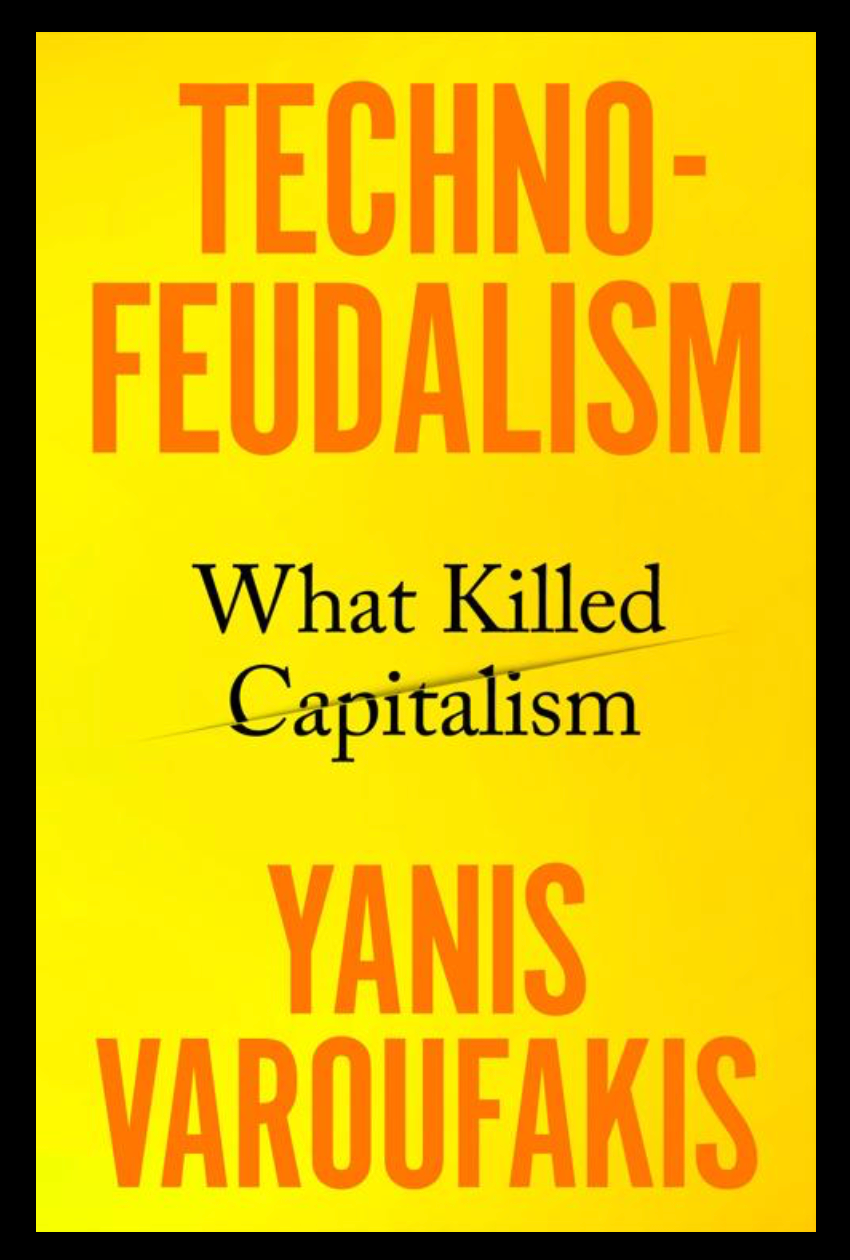
A book that helps to understand what is happening with what the author calls "cloud capital" is "Technofeudalism" by Yanis Varoufakis. He suggests that platform companies have broken free from the traditional capitalist model, abolished a true market-based economy and replaced it with a system where they put both consumers and vendors into a lock-in, benefiting from our work and data given for free while charging both sides a rent to play on the now closed marketplaces. This goes hand in hand with exploiting the policy of central banks and the globally predominant role of the United States capital markets to fund the growth of the platform companies without generating profit.
Yes, the book has an interesting choice of style (Varoufakis wrote it as a letter to his late father and obviously enjoys metaphor from Greek mythology), and the short section where Varoufakis sketches his vision of an alternative economy is best labeled "cute" (e.g in my opinion he misjudges the importance of the availability of capital to scale organizations, which I consider crucial, not only because some things only start to work at a certain scale, but also because research shows that capital helps shift labour and machinery to the more productive firms, benefitting the local economies), but this does not distract from the detailed analysis and explanation that he provides of both the evolution of cloud capital and its effect on us as consumers of ubiquitous cloud platforms.
"Every time we go online to enjoy the services of these algorithms, we have no option but to cut a Faustian deal with their owners. To use the personalised services their algorithms provide, we must submit to a business model based on the harvesting of our data, the tracking of our activity, the invisible curating of our content. Once we have submitted to this, the algorithm goes into the business of selling things to us while selling our attention to others."
Now, a lot of people have already come to realize that the role of platform companies is problematic from a data protection point of view, as well as from a democratic point of view - when algorithms start to shape (social) media output and attention.
Looking through Varoufakis' lens, however we can come to realize that a much larger problem lies in the economic utilization of our data both in creating a novel, total type of attention economy that we have an extremely hard time escaping, and in at the same time creating faux marketplaces that quickly become the sole gateway to consumers, putting sellers into a position of total dependency and easy replaceability.
"Aided by machines, it was waged workers who produced the stuff that was sold to generate profits, which in turn financed their wages and the production of more machines – that’s how capital accumulated and reproduced.
Cloud capital, in contrast, can reproduce itself in ways that involve no waged labour."
In the era of cloud capital, Varoufakis explains, rent trumps profit. Profit is generated by entrepreneurial organizations when they invest into things that would otherwise not have existed. Rent flows from giving privileged access to things that are in fixed supply, of which you cannot produce more even if you were to invest a lot of money. With removing access - such as blocking a company on Amazon's shop and removing its search results on the Google search - cloud providers have it in their hands to disconnect many companies from a large part of their customers. The products created by the cloud platforms aren't produced to be sold; their purpose is to capture and modify our attention, drawing us from the capitalist market to the closed markets of the platform, where the platforms can extract maximum rents from the companies that more and more have no choice but to sell there.
And, again, it's worth reconnecting back to China. According to Varoufakis analysis, Chinese cloud power by far outreaches that of US companies. Why? because Chinese cloud platforms like WeChat have, to a much higher degree than their US counterparts, successfully and deeply integrated finance into their platforms as well.
It's easy to discard some of these positions as leftist theorizing, and it's fair to criticize the notion that capitalism has been replaced by what he calls cloudalism (as some other economists have already done). But when we look at what's happening right now, I do think he's right with the direction this is heading:
In mid March 2026, Reuters and other outlets reported that both OpenAI and Anthropic to be building out large, PE backed service organisations. OpenAI are not just offering guaranteed returns to the PEs, but also early access to new models. This could incur a significant shift in the AI landscape, where up to now access to models had been pretty much equal for all players. It will help increase the lock-in for enterprises on the customer side, as well as the PE services organizations themselves. Portfolio companies of the PEs will likely not have much of a choice in technology. At the same time, these large scale deployments will provide invaluable insight into enterprise operations to the model makers themselves.
At the same time, Jeff Bezos of Amazon launched Project Prometheus, an endeavor to buy up manufacturing companies and re-build them using AI. The goal of this project can very well be read as striving for the commodification of manufacturing, which would significantly broaden the footprint of cloud capital into the physical world.
Finally, most recent pricing changes on AI model use in April 2026 have caused anxiety in the enterprise and consumer markets: GitHub Copilot (a software engineering AI tool) is adapting their billing model, removing access to top tier models like Opus (an AI model) in their Pro plan, requiring people to move to their 4x more expensive Pro+, and the token cost multiplier for current best in class model Opus 4.7 will increase to 9x the previous rate. Anthropic experimented with removing access to Claude Code (their software engineering AI) for new signups on their Pro plan. Overall, all players seem to work to reduce available tokens to the users under current plans at one place or the other.
These all show that the concept of rent and the creation of - for lack of better word let's use Varoufakis' - fiefs - or, if you will, non-markets, is something to keep in mind when considering the shifts in power and dependencies in the technological, and more and more also the physical realm.
Questions to explore
As business leaders, we often tend to get caught up in microeconomics. But now much more than ever, it's crucial to see where you need to step back and look at the bigger picture. Is that proposed outsourcing strategy still a good idea, or is it driven by a narrative that got people rich for the last 30 years but possibly doesn't apply any more? What are the true costs to make your product, your sales dependent on the platform economy - or even just to be a consumer? Are you giving something away that is actually your core IP and should help you differentiate? And even if not, do you have a plan B if you fall out of the goodwill of a platform for one of many reasons? Will there still be suppliers around for a plan B, if you move on the platform now, or are you forcing them down the same path with your platform choice, leaving both locked in and unable to step back out?
Based on this re-aligned mental model of the economy, I think there are a few areas worth exploring in depth. Find below a few thoughts on each.
Antifragile Leadership. With a better understanding of what is happening around us, the case for antifragile leadership seems to become even stronger. To make sure an organization can react to and benefit from the changes that will still emerge from what Babic labels a period of "Interregnum"[1] (in the sense of Antonio Gramsci), we don't just require resilience.
We will need the ability to quickly reorganize and adapt based on complex context, taking decisions that must take into account much more than just an increase in short term shareholder value.
As military strategic initiatives like taking control of geographic choke points are becoming more realistic, redundancies in supply chains and the ability to quickly innovate around both shortages and new market opportunities (e.g. caused by competitors being locked out) are becoming essential factors for survival and growth.
Speed of innovation is key. I am convinced we can only move forward if, together with leaving behind the old mental model of the economy, we also replace the prevailing models of how we organize our work and run our organisations. Resilience, and even more the ability to gain strength in volatility, will not be acquired with top-down management; and it's probably not the time any more where a 12 month budget and following a 3 year forecast provides a competitive advantage.
The importance of process knowledge. Under mounting pressure from political intervention into markets, changes in financing structures, and commodification of entire industries, we need to find back to the heart and soul of what makes our organizations successful. While cloud capital is working hard to acquire market share disregarding classical notions of profit, now is a time to run a company that is both profitable and invests into research and modernization. The advantage of classic private equity backed, strongly leveraged companies to outgrow the competition by maximizing scale-out may be thinning as volatile markets and uncertain overall growth challenges the outlook of such strategies. R&D and innovation may have a comeback, as companies are re-framing process knowledge as a core asset. This doesn't just mean documentation and retention. It's about facilitation and making explicit what it is that allows your organization to do what it does well, and finding out what leaders need to do to enable and foster the growth of process knowledge. I expect it to become more and more relevant to not just be good at doing one thing very efficiently, but to come up with very different ways of achieving the same thing in order to create redundancies and open up the field of exploration. For many organizations, focusing on process knowledge may also mean embracing diversity - bridging the gap between worker generations for knowledge transfer, and fostering a culture that looks at problems from different perspectives.
Digital Strategy. From a digital technology perspective, let me be clear. Now is not the right time for all-in on a hyperscaler or for lock-in of any kind. Organisations are already seeing the drain on cloud rent while at the same time losing their process knowledge, and I've read of the first downsizings "due to rising AI cost" (I think it was a fake argument, but nevertheless). There are two things to focus on: building own digital IP, and cost control. We need to move away from increasing OPEX, and put our money into meaningful technology CAPEX that provides an edge over the market. This will mean owning your infrastructure - not necessarily all of the hardware, but the stack down to a level where it can easily be moved.
But in AI projects, organizations absolutely should start building defendable, proprietary AI within their organisation now, or risk being eaten by commodification and cost in the near future. While this may seem out of reach at first, it isn't; open source models are trailing only shortly behind frontier performance and it has been demonstrated many times that such models adapted to specific tasks and data - thus creating a proprietary model to the organisation - outperform frontier models at much smaller size and cost while leaving behind the OPEX cost structure of the large providers.
These are only short introductions to the question space. I am sure there are also other takeaways, and I'd be curious to hear your thoughts! I think each of these points is worth deep diving on a bit more. Looking at the word count, I'll leave this for some of the next posts.
Footnotes:
[1]: I like the concept of Interregnum much more than the term Zeitenwende ("epochal shift") that I hear a lot these days. I'm convinced the defining property of our times is that a lot is unsettled, and we cannot yet make out what a new order will look like; and neither do we have adequate models to make good predictions about what the options for these new orders are. Zeitenwende, in my reading of the term, carries the connotation that we would know what's on the other side of the Wende ("shift" or "turn"). In the same vein, I also like how Babic positions that we are indeed not seeing the repetition of a certain type of economic cycle, like other economic theorists claim.